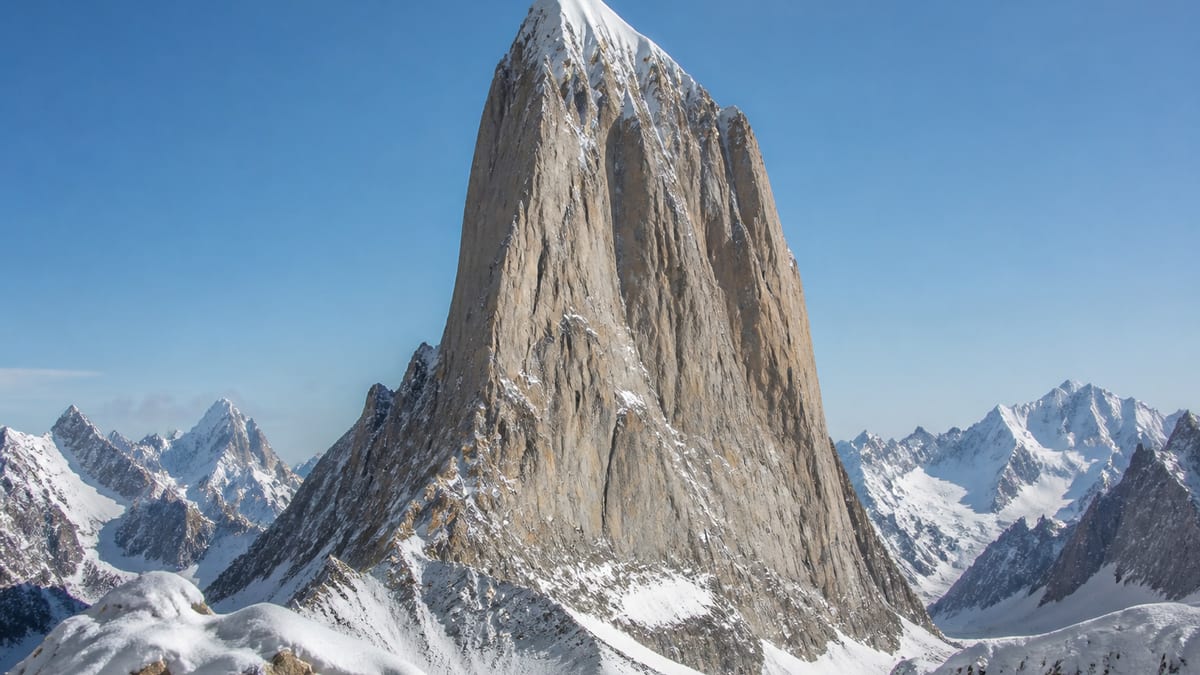
Of the three Mustagh Tower rows on the official table, Mustagh Tower – E is the lowest, and only just. The Pakistan Online Visa System (NADRA) List of Peaks for Gilgit-Baltistan, snapshot dated 2026-08-26, records it at 7,273 metres, a mere eleven metres beneath the NW row and seventy-seven below the W row. Sixty-three of the 104 entries with a height rank above it; thirty-nine rank below.
Eleven metres is roughly the height of a three-storey building. On a mountain of this size it is a rounding error, and it’s a reminder that small details carry big consequences in the high Karakoram. Few details are smaller, or more decisive, than a worn crampon strap or a cracked buckle. So this page pairs the official facts about Mustagh Tower – E with a practical routine for inspecting and maintaining your kit before and during an expedition. The list gives no district, coordinates, route or grade for this row, and we won’t invent any. A quick kit check before the glacier beats a failure on it.
Facts from the official row
- Printed name: Mustagh Tower – E
- Height in the snapshot: 7,273 m
- Tied entry: Diran/Minapin, 7,273 m
- Entries above: 63
- Entries below: 39
- Location and route: not recorded
The Mustagh Tower rows side by side
| Row | Height | Compared with E |
|---|---|---|
| Mustagh Tower – W | 7,350 m | 77 m higher |
| Mustagh Tower – NW | 7,284 m | 11 m higher |
| Mustagh Tower – E | 7,273 m | — |
The compass letters may refer to different parts of a single mountain, but the list doesn’t say so. Each is a separate permit record; quote the letter every time.
Close neighbours
| Entry | Height |
|---|---|
| K-6 | 7,282 m |
| Baltoro Kangri-V | 7,275 m |
| Diran/Minapin | 7,273 m (tie) |
| Baltoro Kangri-III | 7,265 m |
| Malubiting Central | 7,260 m |
Why inspection deserves a routine
Gear rarely fails all at once. A strap frays slowly, a zip gets stiff, a stove jet clogs a little more each day. Without a routine, you notice only when the item stops working, which tends to be at the worst possible moment. A routine turns gradual wear into something you spot on a calm afternoon at home.
Three inspection moments
Plan to inspect your kit at three points: when you buy or receive it, a few weeks before departure, and regularly during the trip. Each stage has a different purpose. The first confirms that the item is what you paid for. The second catches damage from training. The third keeps you safe as conditions take their toll.
Footwear and crampons
Check boot soles for separation and uppers for cracks. Fit crampons to the boots you’ll actually wear, with the socks you’ll actually wear, and practise doing it with gloves on. Look at every point, bar and strap. Carry a small spare-parts kit and know how to use it; the packing guide can serve as a checklist base.
Harness, ropes and hardware
Inspect harness webbing and stitching under good light, paying attention to the belay loop and leg loops. Run ropes through your hands slowly, feeling for soft spots, stiffness or sheath damage. Open and close every carabiner gate, and retire anything that has been dropped from height or shows deep grooves. Write the purchase date of each item on a list; age matters as well as visible wear.
Clothing and sleep systems
Cold kills performance long before it kills people. Check down items for clumping or leaks, insulated gloves for worn palms and outer shells for failed seams. Test the sleeping bag on a cold night at home if you can. Small holes can be patched now; large ones mean replacing the item before you leave.
Stoves, fuel and water
At altitude, melting snow is a full-time job, and a failing stove can end a climb. Clean jets, check seals and run the stove in cold, windy conditions before the trip. Find out from your operator what fuel will be available in the region rather than assuming your usual type can be bought. Carry a backup method for starting it.
Electronics and power
Headlamps, phones, satellite devices and cameras all depend on batteries that suffer in the cold. Test them with fresh cells, note how long each lasts and plan how you’ll keep batteries warm. Check with your operator which communication devices are allowed on your route before packing them.
Eyes, skin and the small things
Glacier glasses and goggles get scratched, lose their straps and sometimes go missing altogether. Inspect the lenses for cracks and carry a spare pair in a hard case, because snow blindness can stop a climber as surely as a broken crampon. Do the same for small items that are easy to forget: lip balm, sunscreen, a needle and strong thread, spare cord, a few cable ties and a roll of repair tape. None of these weighs much, and together they solve a surprising number of problems far from the nearest shop.
A simple gear log
Keep a notebook or spreadsheet with one line per important item: what it is, when you bought it, how many days it has been used and any damage you’ve noticed. Before the expedition, sort the list by age and condition so the riskiest items rise to the top. Bring a photo of the log on your phone. If something fails on the trip, you’ll know at once whether it was new or near the end of its life, and that helps you decide whether to trust similar items. The log also makes insurance claims and warranty returns much easier after you get home.
The daily check on the mountain
Once you are moving, make a brief check part of the morning routine: straps, buckles, crampon fit, glove condition, headlamp. It takes two minutes. Partners should check each other’s harness and tie-in before every roped section, no matter how experienced they are.
Practise repairs before you need them
Knowing how to fix a buckle in a warm kitchen is different from doing it in wind with numb hands. Try your main repairs outdoors, wearing gloves, before you leave.
When something breaks
Decide in advance how you’ll respond. A minor fault might be repaired in camp; a major one may mean that person can’t continue. Agree as a team that nobody climbs with critical gear that has failed. Fix it, swap it or turn back. That agreement is easier to keep if everyone made it at home.
Sharing the load fairly
Group gear, such as ropes, stoves and tents, should be inspected by more than one person, and its weight split fairly. Agree who carries what and who checks what each morning. When responsibilities are written down, nothing important is left at camp because each person thought someone else had it. Remember the support staff too: make sure their equipment is in good condition and suited to the cold, and raise any concerns with your operator.
Storing gear between climbs
After each trip, clean and dry everything before storage. Keep ropes and soft goods away from sunlight, heat and chemicals. Make a note of any item that needs repair, and fix it before the next season rather than discovering the problem when you unpack.
Permits come first
All the gear in the world is useless without permission to climb. Start with the permit application guide and the trekking and mountaineering regulations. Use the exact name “Mustagh Tower – E” with its height on every form, so the eleven-metre gap to NW never causes a mix-up.
Working with an operator on kit
Ask your licensed operator which equipment they provide and how they maintain it. Tents, fixed ropes and kitchen gear often come from the operator, and you have a right to know their condition. The hiring guide offers more questions, and the registering as a tour guide page explains guide licensing.
Travel and season
Gateway routes are described in getting to Gilgit-Baltistan, and the best time to visit guide explains the broad seasons. Your operator will confirm the approach, since the list doesn’t.
Respect and safety
Follow the camping regulations and carry broken or worn-out gear back out with you rather than leaving it on the mountain. For emergencies, the Gilgit-Baltistan Tourist Police number is 1422 within the region and 05811-930055 from outside.
Frequently asked questions
What is the official height of Mustagh Tower – E?
7,273 metres, according to the NADRA snapshot dated 2026-08-26.
Which entry has the same height?
Diran/Minapin is also listed at 7,273 m. The tie says nothing about location.
How does it compare with the other Mustagh Tower rows?
NW is 11 m higher at 7,284 m, and W is 77 m higher at 7,350 m.
Where does this row rank on the list?
Sixty-three entries are higher and thirty-nine are lower.
Does the list give a route or grade?
No route, grade, district or coordinates appear for this row.
When should I inspect my gear?
When you receive it, a few weeks before departure and every day during the trip.
How often should ropes be replaced?
Follow the manufacturer’s guidance and retire any rope with sheath damage, soft spots or an unknown history.
Should I trust operator-provided equipment?
Ask how it is maintained and inspect it yourself where you can.
What should the team do if critical gear fails?
Repair it, replace it or turn back. Agree on that rule before the trip starts.
What number should I call in an emergency?
Gilgit-Baltistan Tourist Police: 1422 in the region, 05811-930055 from outside.
Source
Information on name and height is from NADRA’s Gilgit-Baltistan List of Peaks (Pakistan Online Visa System), snapshot 2026-08-26, and our live page. No district, route, grade or coordinates are given for this row.