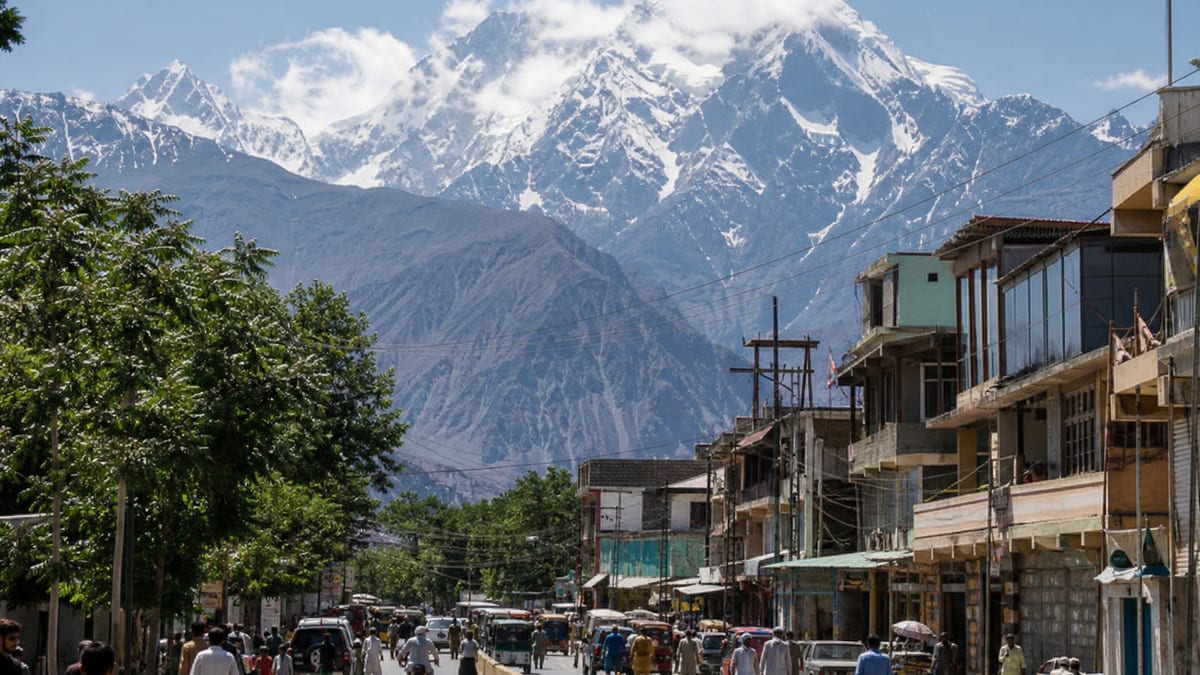
Start in Gilgit and you’ll meet Shina early. Shina is the language this site ties most closely to Gilgit. The Gilgit district page names it as the local language of the district, the Ghizer district page lists it among the common languages there, and the Hunza district page names it alongside Burushaski and Wakhi. The tourism department’s culture page also lists Shina among the main languages of Gilgit-Baltistan. If you’re landing in Gilgit City and heading out to Kargah, Naltar or the western valleys, Shina is the local language you’re most likely to hear first.
This page isn’t a phrasebook or a language course. Our sources don’t publish Shina phrases, grammar, speaker numbers or dialect maps, so we don’t either. What you’ll find here is a clear map of where Shina is recorded on this site, how it sits beside Urdu and English, and how to use a few local words as the simple courtesy our district pages describe.
Where Shina is recorded
The Gilgit district page
The Gilgit district page names Shina as the local language and says English and Urdu are also widely spoken. That’s the record this article is filed under. The district page is careful about its limits: speaker counts aren’t part of the record, and other regional languages, including Balti and Burushaski, are filed with Ghanche and Hunza rather than with Gilgit.
The Gilgit destination page carries the same picture from a trip-planning angle. Gilgit is where many visitors land, plan the Kargah day and decide which valley comes next, so it’s also where many travellers first hear Shina spoken in markets, taxis and guesthouses.
Hunza
The Hunza district page says official tourism information identifies Burushaski, Shina and Wakhi among the local languages, while Urdu and English are widely used in tourism and communication. So Shina isn’t only a Gilgit language on our pages. It appears in the Hunza record too, though the Hunza page puts its own emphasis on learning a few words of Burushaski.
Ghizer
The Ghizer district page names Shina, Khowar, Burushaski and Wakhi, with Urdu and English also widely spoken. The Ghizer destination page repeats that list and suggests learning a few words of Khowar as a visitor courtesy. That’s a useful reminder: in the western valleys, Shina shares the ground with other languages, and the local guide or host is the best person to tell you which one people use in a particular village.
The culture page
The culture overview lists Shina among the main languages of Gilgit-Baltistan, beside Balti and Burushaski. It keeps the named languages next to music, dance, crafts and hospitality, which is a good way to think about them as a traveller. Language is part of the living culture you’re visiting, not a separate subject.
Where Shina isn’t assigned
It’s just as useful to know what the record doesn’t say. Our pages don’t describe Shina as the only language of Gilgit. The district sources name Urdu and English as widely spoken, and other valleys carry their own lists. We also don’t assign Shina to districts whose pages don’t name it. If a district page doesn’t list a language, borrowing one from next door would be a guess, and we’d rather leave the gap than fill it with something that isn’t on the record.
Urdu and English alongside Shina
For most visitors, Urdu and English do the practical work. The Gilgit district page says both are widely spoken, and the Hunza page notes they’re used in tourism and communication. Hotel staff, licensed guides, drivers and shopkeepers in the main towns will usually manage at least one of the two.
That means you don’t need Shina to get around. You can book a room, arrange transport, buy supplies and ask directions in Urdu or English. Shina comes in as a courtesy, a way of showing that you’ve noticed where you are.
A few words as a courtesy
The Hunza page, when it discusses Burushaski, and the Ghizer page, when it discusses Khowar, both treat a few local words as a courtesy rather than a test. The same idea applies to Shina in Gilgit. Nobody expects fluency from a visitor. A greeting, a thank-you and a little patience go a long way.
Because our sources don’t publish Shina phrases, we’re not printing any here. The best approach is simple: ask your guide, driver or host to teach you a greeting when you arrive. People usually enjoy being asked, and you’ll learn the version that’s actually used locally, with the right pronunciation. Write it down, use it, and don’t worry about getting it perfect.
Shina and culture in Gilgit
The culture overview keeps language beside music, dance, crafts and hospitality. In practice, that means you’ll often meet Shina in social settings: a shared meal, a conversation over tea, a local event or a visit to a village. Listening is part of the experience. You don’t need to understand every word to appreciate how a place sounds.
Gilgit’s role as a crossroads helps explain why several languages turn up in the same area. The Silk Route legacy in Gilgit page covers the city’s long history as a meeting point, and the Kargah Buddha page covers one of the oldest heritage sites near the city. Neither page is a language history, but both give context for a region where people have long met, traded and travelled.
Language and respect
Language is one part of a wider courtesy. Our visitor customs and dress page covers modest clothing, behaviour at religious sites and asking before photographing people. Those habits matter at least as much as any greeting. A visitor who dresses respectfully, asks permission and listens will be welcomed whether or not they know a word of Shina.
If you’re photographing people, ask first. If you’re invited into a home, follow your host’s lead. If you’re unsure about something, ask your guide. These are small things, but they’re what local hospitality expects in return.
Planning a trip where Shina is spoken
Most trips that touch Shina start in Gilgit. Gilgit Airport is one of the two airports named for the region, and the city is the road base for the western valleys. From there, travellers head to Gilgit City sights, the Kargah day, Naltar, or onward to Hunza and Ghizer.
A few practical points:
- Use Urdu or English for bookings, transport and logistics.
- Ask a local guide or host for a Shina greeting on your first day.
- Read the Gilgit district page first, then the culture overview.
- If you’re continuing to Hunza or Ghizer, read those district pages too, because the language mix changes as you move.
- Check road conditions before any onward drive, especially toward the high passes.
For lodging, the Gilgit district page names Serena Hotels Gilgit with the city and Turgil Green Resort with Naltar. Those are the properties on the district record. We don’t add others here.
Learning from a guide
A licensed guide is often the best language resource you’ll have. They can tell you which language is spoken in a given village, teach you a greeting, explain local etiquette and help you avoid misunderstandings. Our tour guide regulations page covers what to expect from licensed guides in the region.
If you’re travelling independently, your guesthouse host or driver can play the same role. Ask questions, be curious and accept corrections with good humour.
Spelling and naming
You’ll usually see the name written as Shina in English. Our pages use that spelling throughout. If you see a slightly different spelling elsewhere, it’s most likely a transliteration difference rather than a different language. When in doubt, follow the spelling used on the district record.
What this page won’t include
To keep this page accurate, we leave out several things our sources don’t publish:
- Speaker counts or population figures for Shina speakers
- Dialect maps or lists of dialects
- Grammar notes or phrase lists
- Claims about the language’s origin beyond what’s on our pages
- Language classes, tutors or courses for hire
If those details are published in a source we use, we’ll add them with a citation. Until then, we’d rather keep the page short on claims and long on practical, accurate guidance.
Related languages
Shina sits beside several other languages on this site:
- Balti, filed with Ghanche and named for Skardu and Shigar
- Burushaski, filed with Hunza
- Wakhi, named for Hunza and Ghizer
- Khowar, suggested as a courtesy language in Ghizer
The Languages hub lists them all, and the Culture of Gilgit-Baltistan page puts them in wider context.
Frequently asked questions
Where is Shina spoken, according to this site?
The Gilgit district page names Shina as the local language of Gilgit. The Hunza and Ghizer district pages also list Shina among their local or common languages.
Does the culture page name Shina?
Yes. The tourism department’s culture page lists Shina among the main languages of Gilgit-Baltistan, alongside Balti and Burushaski.
Is Shina the only language spoken in Gilgit?
No. The Gilgit district page says English and Urdu are also widely spoken, and other languages are named in neighbouring districts.
Do I need to speak Shina to visit Gilgit?
No. Urdu and English are widely spoken, and our district pages treat a few local words as a courtesy, not a requirement.
Does this page teach Shina phrases?
No. Our sources don’t publish Shina phrases, so we suggest asking your guide or host for a greeting when you arrive.
How many people speak Shina?
Our sources don’t publish a speaker count, so we don’t give one.
Is Shina spoken in Hunza?
The Hunza district page names Shina among the local languages, together with Burushaski and Wakhi.
Is Shina spoken in Ghizer?
Yes. The Ghizer district page lists Shina with Khowar, Burushaski and Wakhi as common languages there.
What’s the best way to learn a Shina greeting?
Ask a licensed guide, driver or guesthouse host on your first day. You’ll learn the local form and pronunciation directly.
Which page should I read first?
Start with the Gilgit district page, then read the culture overview and the Languages hub.
Source
District Gilgit tourist destinations (Tourism Department) · Tourism, Sports, Culture, Archaeology & Museums Department, Government of Gilgit-Baltistan · Accessed 2026-08-27 · https://visitgilgitbaltistan.gov.pk/district/id/1