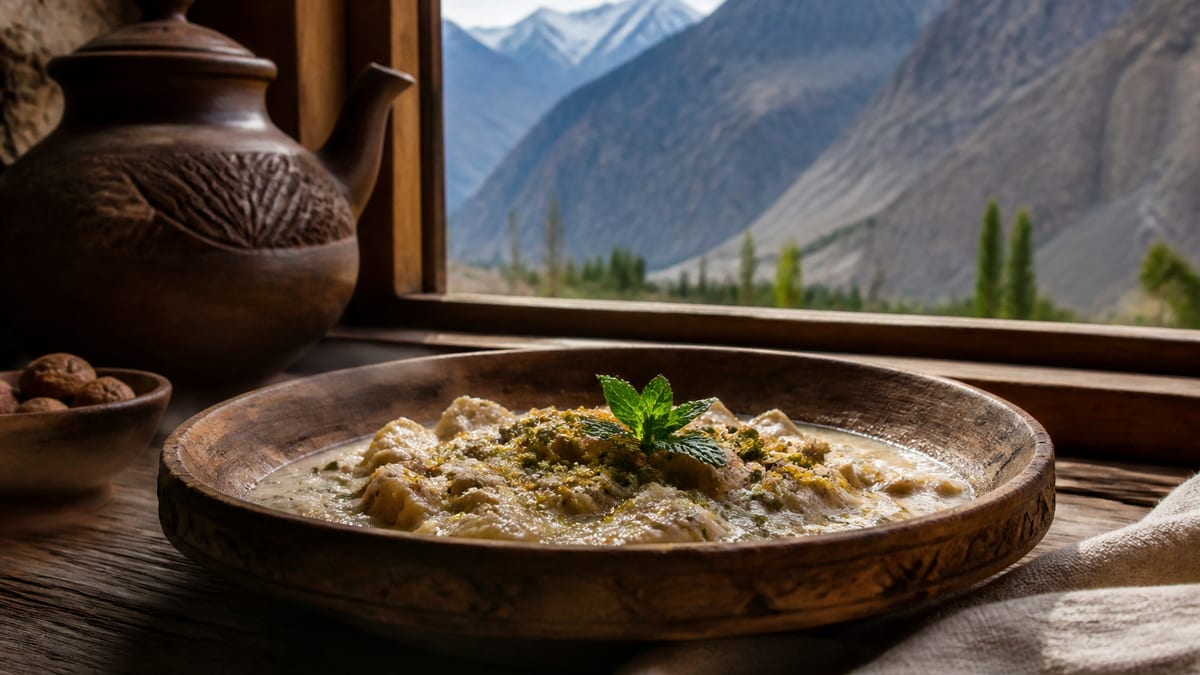
Balay is one of the six traditional dishes the Gilgit-Baltistan tourism department names — and the one most clearly tied to a place on this site. The department describes it as noodles with goat meat and broth. Our Hushe Valley page, written for trekkers heading into the Karakoram from Baltistan, suggests trying it and calls it “a hearty noodle soup”.
This page brings those two descriptions together and puts Balay in the setting where our pages mention it: the Balti-speaking villages of Ghanche, the guesthouses of Hushe and the long cold months that shape life there. As with every page in our food section, there’s no recipe — our sources don’t give one.
What the department records
The department culture page, “We All Are Culture”, accessed on 27 August 2026, lists Balay among the traditional dishes of Gilgit-Baltistan and describes it as noodles with goat meat and broth.
The culture page doesn’t say which district Balay belongs to, how the noodles are made or when the dish is eaten. Our traditional dishes page and culture overview repeat the description without adding to it.
What the Hushe Valley page adds
The Hushe Valley page is the only place on this site, outside the food section, that mentions Balay. Its culture note reads:
> People in Hushe speak Balti. Try balay, a hearty noodle soup, along with apricot jam and butter tea.
Two things stand out.
- The descriptions agree. “Noodles with goat meat and broth” and “a hearty noodle soup” fit together. The Hushe page doesn’t mention goat, and the culture page doesn’t call it hearty — but neither contradicts the other. Unlike chapshuro, which our pages describe in two conflicting ways, Balay’s two descriptions are consistent.
- It’s a local tip, not an assignment. The Hushe page recommends trying Balay in Hushe. That isn’t the same as saying Balay comes only from Hushe or from Ghanche. The culture page still assigns it to no district — and we keep it that way.
Balay in Baltistan: the setting our pages describe
Hushe and its people
The Hushe page describes a high side valley in Ghanche District, running north from Khaplu towards Masherbrum. Hushe village is the last settlement and the trailhead for several base camps and for the Gondogoro La exit from the K2 trek. The page calls it a working village — stone-and-timber houses with barley and apricot terraces.
It also notes that Hushe men have worked as cooks, porters and guides on Karakoram expeditions since the 1960s, and that the village is still one of Baltistan’s great mountaineering communities. Our pages don’t describe what expedition cooks prepare — so we don’t connect that history to any dish.
Where you’ll eat
The Hushe page says the village has basic family-run guesthouses and campsites, with “simple Balti meals”. Advance booking isn’t usual — your guide or driver will arrange a room. Most trekkers spend at least one night in Khaplu on the way up, which has more comfortable hotels and family guesthouses.
If you hope to try Balay, the guesthouse is where to ask. Our pages don’t name any guesthouse, restaurant or hotel that serves it — and we won’t guess.
Language at the table
The Hushe page says people in Hushe speak Balti. Our Ghanche district page names Balti as the local language, with Urdu and English also spoken. The Balti page describes a few local words as a courtesy rather than a test. A greeting and a word of thanks in Balti will go further than any amount of food knowledge.
Dance and celebration
Ghanche is also known for its dances. Our Ghanche destination page says people mark festivities with two named dances, Mandoq Taimo and Ragi Taimo, and the Hushe page points readers to dances of Ghanche. Neither page links Balay to a festival or celebration — so we don’t.
Balay alongside Baltistan’s other food tips
Our Baltistan pages mention a handful of foods — and it helps to see them side by side.
| Page | Food mentioned |
|---|---|
| Hushe Valley | Balay (“a hearty noodle soup”), apricot jam, butter tea, simple Balti meals |
| Skardu destination | Butter tea, apricot soup, chapshuro |
| Shigar destination | “Local food” as part of traditional Balti life, without naming dishes |
Butter tea appears on both the Hushe and Skardu pages. The department’s list includes Namkeen tea, but our sources don’t say whether the two are the same — so we keep them apart. If you’re travelling from Skardu to Khaplu and on to Hushe, you can ask about all of these along the way.
Seasons in Hushe
Balay is described as a broth-based dish, and Hushe is a cold place for much of the year. Our Hushe page gives the seasons plainly:
- June to September is the time to visit. July and August are the main trekking months.
- September is quieter and often clear, with golden colour in the villages and cold nights.
- October to April the valley is freezing and isolated, and high trekking isn’t recommended.
Our pages don’t say whether Balay is eaten more in one season than another. Ask your host.
Before you go: practical notes from our pages
These points come from the Hushe page and the department FAQ. None of them is about Balay itself — but they’ll shape any meal you eat in the valley.
- Acclimatise. The Hushe page advises a rest day in Hushe before heading for base camps or the Gondogoro La. A slow day in the village is also a good day to eat with your hosts.
- Bring cash. The Hushe page says the only ATMs are in Khaplu — so bring enough for guides, porters and tips. The FAQ recommends cash across the region because cards aren’t widely accepted; see local currency and cash.
- Pack a sleeping bag. The Hushe page expects simple rooms and pit toilets.
- Camp cleanly. On treks you camp. The FAQ requires leave-no-trace principles and proper waste disposal in designated camping areas; see camping regulations.
- Look after porters and animals. Our Ghanche destination page says porter and mule hire is regulated, and asks you to use licensed owners, not overload animals and provide adequate food and water.
Questions to ask about Balay
If Balay is on the table — or you’d like it to be — these questions are polite and useful:
- Do you call this balay here, or something else?
- Is it usually made with goat, or does the meat change?
- Are the noodles made at home?
- Is it a cold-weather dish, or eaten all year?
- Is Balay the same in Hushe as in other parts of Baltistan?
If you don’t eat meat, say so early and politely. The department’s description includes goat meat — and our pages can’t tell you whether other versions exist.
As a guest
The department FAQ asks visitors to respect local culture, dress modestly and remove shoes before entering a mosque or a local house. Our visitor customs and dress page sets it out and deliberately stops there — follow your host’s lead for everything else.
Ask before photographing people, including in a kitchen or at a family meal. The Skardu destination page specifically asks visitors to ask before photographing people — especially women — and the same courtesy applies in Hushe.
If you’ll be staying with a family rather than in a guesthouse, read homestay regulations. The FAQ says homeowners must obtain a licence before offering accommodation.
What this page won’t tell you
- A recipe, noodle type or cooking time. Not in our sources.
- A district of origin. The culture page assigns none — and the Hushe tip isn’t an assignment.
- Restaurants or guesthouses that serve it. Not listed on this site. Restaurants need a tourism department licence, according to our restaurant regulations page.
- Nutrition or health claims. We don’t make them, including about cold or altitude.
Related reading
See the other named dishes on the food hub, including Gyaling / Gral and Marzan. For the valley itself, start with Hushe Valley and the Ghanche destination page.
Frequently asked questions
What is Balay?
The department culture page describes it as noodles with goat meat and broth. Our Hushe Valley page calls it a hearty noodle soup.
Do the two descriptions agree?
Yes. They fit together — though the Hushe page doesn’t mention goat and the culture page doesn’t call it hearty.
Which district is Balay from?
The culture page doesn’t assign it to one. Our Hushe Valley page — in Ghanche District — suggests trying it there.
Is Balay only eaten in Hushe?
Our pages don’t say so. The Hushe tip is a recommendation, not a statement of origin.
Is there a Balay recipe on this site?
No. Our sources don’t give preparation steps.
Where can I eat Balay in Hushe?
This site doesn’t name a guesthouse or restaurant that serves it. Hushe has basic family-run guesthouses with simple Balti meals — ask your host.
What else does the Hushe page suggest trying?
Apricot jam and butter tea.
When is the best time to visit Hushe?
The Hushe page says June to September, with July and August the main trekking months.
What language do people speak in Hushe?
The Hushe page says Balti. The Ghanche district page adds that Urdu and English are also spoken.
Is Balay vegetarian?
The department’s description includes goat meat. Ask your host about any alternative.