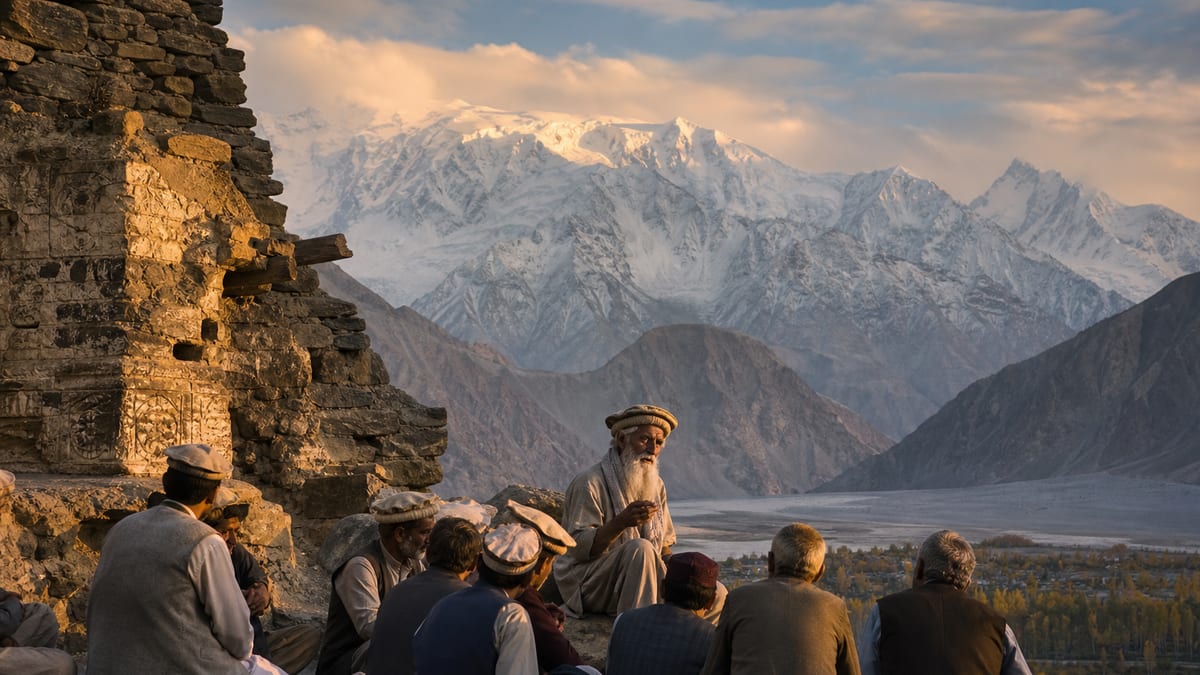
If you’re heading to Hunza with history in mind, the forts are where you’ll want to start. The tourism department’s Hunza page lists the district’s cultural heritage sites as Altit and Baltit Forts, historic polo grounds, watchtowers, mosques, and the Sacred Haldekish Rocks in Ganish. It also notes traditional dresses, tunes, dances and cuisines, and identifies the forts as restored attractions for visitors interested in heritage.
This page brings the fort story together in one place. It draws on the department’s district description and on our Altit Fort and Baltit Fort place pages. It doesn’t publish ticket prices as fact, because those change and our own pages report different figures. For the wider culture of the valley, read cultural heritage of Hunza.
Two forts, one ruling family
Altit and Baltit are a few kilometres apart in central Hunza, and their stories are linked. Both were seats of the Mirs, the rulers of Hunza.
Our Altit page says Altit was the first seat of the Mirs of Hunza. About three centuries after Altit was built, the ruling family moved up the hill to Baltit. Local legend blames a quarrel between two royal brothers. Our Baltit page says Baltit was then home to the ruling family of Hunza, once known as Kanjut, for about 700 years, until the Mirs moved to a new palace further down the hill in 1945.
That’s the simple version. Dates for buildings this old come from conservation work and tradition, not written records, so treat them as approximate.
Altit Fort
Setting. Our Altit page places the fort in Altit village, at about 2,400 m, on a rock that drops roughly 300 m to the Hunza River. It’s about 3 km below Karimabad.
Age. The oldest part is the Shikari Tower, a slim watchtower on the cliff edge. The page says it’s about 1,100 years old and considered the oldest monument in Gilgit-Baltistan.
Name. The name is usually explained in Burushaski as “this side down”. One of its earliest names was Hunukushal.
Restoration. After the Mirs left, the fort slowly decayed. The Aga Khan Trust for Culture restored it with support from Norway, and it opened to visitors in 2007. Work on the old village, the khun, continued afterwards, and the project received a UNESCO Asia-Pacific Award of Distinction in 2011. The page says part of each ticket goes to the Altit Town Management Society, which looks after the village.
What you see. The Shikari Tower, a fort interior of low doorways and carved wooden pillars, a roof above the cliff with Nagar across the valley, the restored old village, and the Royal Garden of old apricot and mulberry trees below the fort.
Baltit Fort
Setting. Our Baltit page places the fort on a ridge above Karimabad, with Ultar Sar rising behind it. It’s a 15–20 minute walk uphill from the bazaar.
Age. Conservation work dated the core towers to about the 8th century CE, and the building shows Tibetan influence. Much of it was rebuilt in the 16th century.
The Balti connection. In the 16th century, the page says, Mir Ayasho II married Shah Khatun, a princess from Skardu. Her father, Abdal Khan, sent Balti craftsmen who rebuilt the fort, along with a cannon dated 1539 as part of the dowry. That marriage links Hunza’s best-known building to Baltistan.
The Great Game. British troops occupied Baltit in 1891.
Decline and restoration. After the Mirs moved out in 1945, the fort began to decay. Mir Ghazanfar Ali Khan later gave it to the Baltit Heritage Trust. After a survey by the Royal Geographical Society, the Aga Khan Trust for Culture restored it, finishing in 1996. It has been on UNESCO’s World Heritage Tentative List since 2004 and is now run as a museum by the Baltit Heritage Trust.
What you see. Three floors of rooms, carved beams and lattice windows in the Tibetan and Balti building tradition, a modest museum collection, and a roof terrace that looks across the valley to Rakaposhi, up to Ultar Sar and the Ladyfinger spire, and down to Altit.
Altit or Baltit?
Our place pages suggest seeing both if you can. Altit is older, smaller and more atmospheric, with its cliff and garden. Baltit is larger, with a museum and the best rooftop view of the valley. The two are only a few kilometres apart and fit easily into one day.
Beyond the two forts
The department’s list doesn’t stop at Altit and Baltit.
Ganish. The district page names Ganish Historical Settlement among Hunza’s destinations and describes traditional architecture and historical structures reflecting communities that lived along the old trade routes. Our Hunza destination page calls Ganish an old village with watchtowers.
The sacred rocks. The department lists the Sacred Haldekish Rocks in Ganish. Our Hunza destination page refers to the Sacred Rock of Hunza, with its ancient inscriptions, near Ganish. The two sources use different names. We don’t claim whether they describe the same site, so check locally.
Watchtowers, mosques and polo grounds. The department names historic polo grounds, watchtowers and mosques as heritage. It doesn’t single out particular buildings, and we don’t add names it doesn’t give.
How the forts tie into Hunza’s wider history
The Hunza district page says the district has a long historical connection with the ancient Silk Road. Our Silk Route legacy in Gilgit page covers what the department says about that trade history. We don’t claim the forts were built for any particular trade purpose; the sources don’t say so.
For older history in the region, see Kargah Buddha and early Buddhism. For how the tourism department itself took shape, see tourism department background and history.
Visiting the forts
Both forts are reached from Karimabad, in central Hunza. Our place pages say Karimabad is about 100 km north of Gilgit on the Karakoram Highway. See getting to Gilgit-Baltistan.
Tickets. Both place pages say a guided tour is included in the ticket and advise paying in cash. Our pages report different ticket figures from different sources and years, so we don’t repeat them here. Confirm the current rate at the gate.
Opening. Both pages say the forts are open daily from about 9 am to 5 pm, with shorter hours at Baltit in winter.
Stairs. Both forts have low doorways and steep stairs, and neither is step-free.
Drones. Both pages say drones need permission.
Respect. Altit khun is a living village. Dress modestly, keep your voice down and ask before photographing people. See visitor customs and dress and visiting cultural sites.
Season. Blossom in April and autumn colour in October are the favourite times, but Baltit runs as a museum all year. See best time to visit.
Staying and eating near the forts
Most visitors base themselves in Karimabad, which our Baltit page says puts you within walking distance of the fort, the bazaar and the old lanes.
A few places near the forts appear on this site:
- Serena Altit Fort Residence, which our Altit page says sits in the Royal Garden beneath the fort.
- Baltit Heritage Inn, named on the tourism department lodging list for Hunza District.
- Eagle’s Nest Hunza, higher up at Duikar, also on the department list and known for its sunrise views.
A listing on this site isn’t proof that a business is open this season. Check directly before you book.
For food, our Altit page mentions KhaBasi Café in the Royal Garden, in the Mir’s old winter residence, run by a local women’s enterprise. Try local dishes such as chapshuro.
A simple heritage day
Our place pages suggest walking down the old water channel from Karimabad to Altit in the morning, touring the fort and village, then having lunch in the Royal Garden. In the afternoon, go back up to Baltit for its tour and rooftop view. If you have time, add a walk through Ganish.
Frequently asked questions
Which forts does the department name in Hunza?
Altit Fort and Baltit Fort. The district page describes them as restored attractions for visitors interested in heritage.
Which fort is older?
Altit. Our Altit page says its Shikari Tower is about 1,100 years old and considered the oldest monument in Gilgit-Baltistan.
Why did the Mirs move from Altit to Baltit?
Our Altit page says local legend blames a quarrel between two royal brothers. The move came about three centuries after Altit was built.
Who restored the forts?
Our place pages say the Aga Khan Trust for Culture restored both. Baltit was finished in 1996, and Altit opened to visitors in 2007.
Is Baltit Fort a UNESCO World Heritage Site?
Not fully. Our Baltit page says it has been on UNESCO’s World Heritage Tentative List since 2004.
Did Altit win an award?
Yes. Our Altit page says the restoration project received a UNESCO Asia-Pacific Award of Distinction in 2011.
What is the Balti link to Baltit Fort?
Our Baltit page says Balti craftsmen rebuilt the fort in the 16th century after Mir Ayasho II married a princess from Skardu.
What other heritage sites does the department list?
Historic polo grounds, watchtowers, mosques, and the Sacred Haldekish Rocks in Ganish.
How much are fort tickets?
Our pages report different figures from different sources, so we don’t repeat them here. A guided tour is included; confirm the rate at the gate.
Can I fly a drone at the forts?
Only with permission. Both place pages say drones need permission, so ask at the ticket desk.
Source
District Hunza tourist destinations (Tourism Department) · Tourism, Sports, Culture, Archaeology & Museums Department, Government of Gilgit-Baltistan · Accessed 2026-08-27