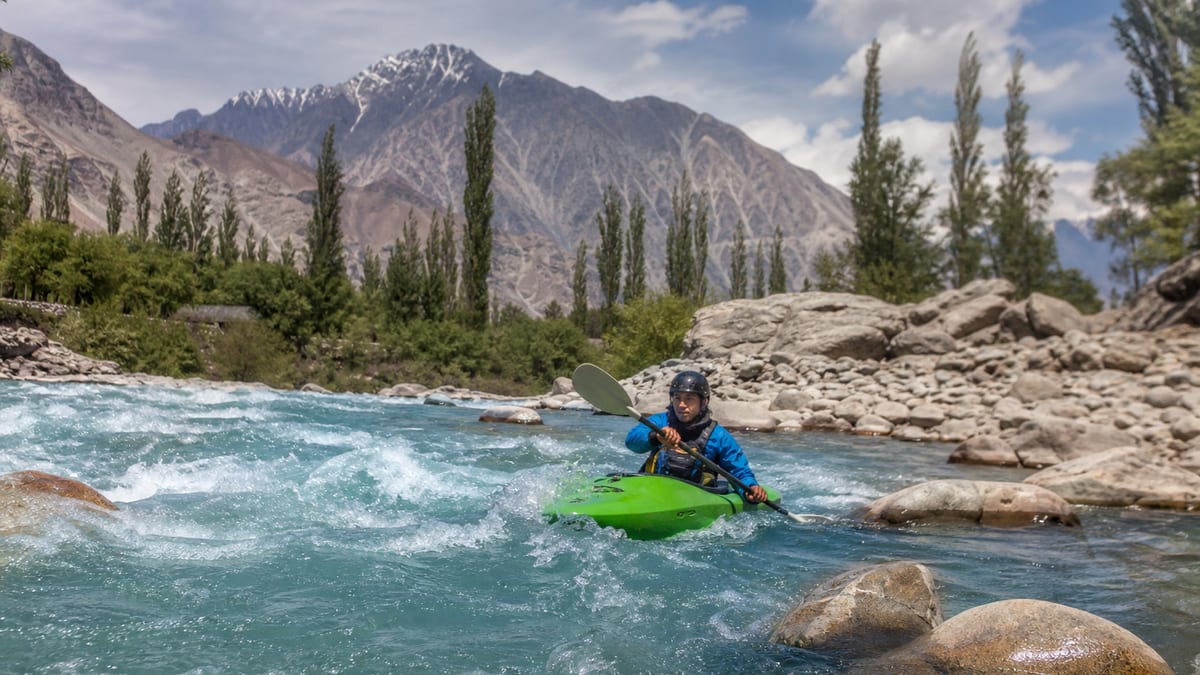
The tourism department FAQ lists eight outdoor activities for Gilgit-Baltistan: trekking, mountaineering, rock climbing, white water rafting, paragliding, skiing, ski traversing and ice skating. That list is the official starting point.
On its own, a list doesn’t tell you much about planning a trip. This page takes each activity in turn and answers three questions: which published rule applies, where on this site the activity is linked to a real place, and what we can’t tell you. Some activities have a lot of support on our pages. Others have little beyond their name on the list — and we say so instead of filling the gap.
We don’t publish operator schedules, difficulty grades, prices or a ranking of “best” spots — our sources don’t contain them.
Four rules that cover almost everything
Before the activities, it helps to know the four rule pages most of them fall under. Each one repeats a sentence from the department FAQ:
| Rule page | What the FAQ says |
|---|---|
| Trekking and mountaineering regulations | Activity must be registered with the tourism department. Restricted areas need a permit before the activity starts, and a licensed guide and porter are mandatory there. |
| Adventure sports operator regulations | Operators need a tourism department licence, must meet safety standards, provide trained and licensed guides, use quality equipment and follow department guidelines. |
| Water sports regulations | Water sports such as white water rafting and kayaking are regulated by the tourism department and need licensed guides and department safety guidelines. |
| Porter and mule hiring regulations | Porters and mule owners must be licensed. Animals must not be overloaded and must get adequate food and water. |
Three more apply depending on where you go: camping (designated areas, a tourism department permit before tents go up, leave no trace), national park visits (a Wildlife Department permit and park rules) and photography restrictions (no photography in restricted belts, at military installations or in sensitive border areas).
This website doesn’t issue any permit or licence.
Activity by activity
1. Trekking
Rule: register with the tourism department. Restricted-area treks need a permit first, plus a licensed guide and porter.
On this site: trekking has more support than any other activity. Our trekking and mountaineering permits guide outlines the published process: an online application, fees, insurance, supporting documents and approval. It also explains why most permit-bound trips need a licensed operator. Place pages describe specific routes. The K2 Base Camp page explains that the Baltoro approach is a restricted zone and that porters are hired through village associations at Askole. The Shimshal Valley page describes the Shimshal Pass trek and says no guide or permit is needed for the walk to the Yazghil Glacier edge, but advises against going onto the ice without a local guide.
What we can’t tell you: a complete list of restricted zones, or current fees — ask the issuing office or your licensed operator.
2. Mountaineering
Rule: the same registration and restricted-area rule as trekking. Our permits guide adds that, under the department’s guidance, climbing expeditions need the appropriate permits, a registered tour company and insurance where it applies.
On this site: the mountains section lists peaks taken from the official permit list. The permits guide explains the difference between a trekking permit and a climbing permit, and what royalty is for.
What we can’t tell you: which peak suits your experience — that’s for a licensed operator and your own climbing record.
3. Rock climbing
Rule: if you climb through a commercial provider, the adventure sports operator rule applies. If a climb is part of a mountaineering trip, the trekking and mountaineering rule applies too.
On this site: rock climbing appears in the FAQ list and in the activity lines on several destination pages, including Astore and Diamer. We have no page that names a climbing crag.
What we can’t tell you: crags, routes or grades. We won’t invent any.
4. White water rafting
Rule: water sports regulations, which require licensed guides and department safety guidelines.
On this site: the Ghizer destination page mentions rafting among the usual mountain activities and says water sports need licensed guides. The Kharmang destination page says there is no listed rafting product specific to Kharmang. It adds that if a boat or raft is offered on a Skardu-side lake day, the licensed water-sport rules apply.
What we can’t tell you: named rafting rivers, sections or seasons.
5. Paragliding
Rule: if a commercial operator runs it, the adventure sports operator rule applies.
On this site: the Shandur Pass page says recent editions of the polo festival have added paragliding, cultural nights and a camping village.
What we can’t tell you: launch sites, operators or whether paragliding will be offered at a future festival.
6. Skiing
Rule: no ski-specific rule appears in the FAQ. The adventure sports operator rule applies to commercial providers, and photography restrictions apply near military facilities.
On this site: the Naltar Valley page has the most detail. It says that from about December to February the Pakistan Air Force runs ski slopes at Naltar that have hosted national competitions, and that access depends on snow and PAF activity. It also says the ski area is next to a PAF facility. Point your camera at the forest and the lakes — not the base.
Investment, not a resort: the FAQ lists ski resorts among potential tourism investments. A listed idea isn’t a built resort.
7. Ski traversing
Rule: treat it as an adventure activity. If the route enters a restricted area, the trekking and mountaineering rule applies too.
On this site: ski traversing appears only on the FAQ list and in the activity lines on destination pages. No page names a route.
What we can’t tell you: routes, seasons or operators. Ask a licensed operator directly.
8. Ice skating
Rule: no skating-specific rule is published.
On this site: the Khalti Lake page says the lake usually freezes in winter, when people walk on it, skate and play ice hockey. It also warns that warmer winters have made the ice less reliable, and says never to walk on the ice unless local people are already on it and the organisers say it’s safe. The Kachura Lake page gives similar advice: don’t walk on the frozen lake unless locals say it’s safe that day. Winter events are covered on the Khalti Ice Hockey Festival and Sevendays Winter Feast pages.
What we can’t tell you: rink locations, equipment hire or festival dates for future years.
Other activities on our place pages
Some activities that aren’t on the FAQ’s eight-item list still come up on our place pages:
- Boating and jet skis. The Attabad Lake page says boats and jet skis run from the jetties. It advises asking for a life jacket for everyone before agreeing a price, and walking away if there aren’t any. It also says swimming is generally prohibited because the water is dangerously cold.
- Fishing. The Sadpara Lake page says you need a fishing licence from the Fisheries Department and that wardens check. The Khalti page also says a licence is needed.
- Wildlife viewing. The FAQ says it’s allowed in designated areas with a wildlife department permit. See wildlife viewing regulations.
Matching activities to seasons
Our best time to visit guide sets out four windows. Here’s how the activities above fit them — based only on what our pages say:
- Summer (June–August). All three named high passes are reliably open. It’s the main season for boats and jet skis at Attabad, and for festival paragliding at Shandur.
- Autumn (September–October). The guide describes it as a strong window for valley scenery while the passes close through October.
- Winter (November–March). Skiing at Naltar runs from about December to February, and ice activities depend on whether Khalti or other lakes freeze.
- Spring (April–May). The guide calls it a valley-focused window, with the high passes only just opening.
Safety before adrenaline
The department’s travel smart, stay safe advisory includes points that apply to every activity on this page:
- Give your body time to adjust to altitude, and don’t plan strenuous hikes straight after arriving.
- Don’t walk onto a glacier without proper knowledge and equipment.
- Never assume a shallow-looking stream is safe to cross. Water levels can rise fast.
- Don’t camp right beside streams or river channels.
- Use qualified local guides and suitable equipment for trekking and mountaineering.
Our packing guide covers clothing and kit for trekking and outdoor activities, and our travel safety guidance page sets out the department’s general advice.
Choosing who to go with
For any activity where someone else provides the equipment, the guide or the boat, ask to see their licence. Our hiring a tour operator guide covers the questions to ask, and the tour guide regulations page explains that guides must be licensed. Operator names on this site come from department directories. A listing doesn’t prove that a business is open — or that it offers a particular activity.
Frequently asked questions
Which outdoor activities does the department list?
Trekking, mountaineering, rock climbing, white water rafting, paragliding, skiing, ski traversing and ice skating.
Do I need a permit to trek?
You must register with the tourism department. Restricted-area treks need a permit first, plus a licensed guide and porter.
Where can I ski in Gilgit-Baltistan?
Our Naltar Valley page says the Pakistan Air Force runs ski slopes there from about December to February, depending on snow and PAF activity.
Is rafting regulated?
Yes. The FAQ says water sports such as white water rafting and kayaking need licensed guides and department safety guidelines.
Where can I paraglide?
Our Shandur Pass page says recent polo festivals have included paragliding. We have no page that names a launch site.
Where can I go ice skating?
Our Khalti Lake page says people skate there when the lake freezes in winter. The ice isn’t reliable every year.
Do you publish difficulty grades or prices?
No. Our sources don’t include them.
Can I swim at Attabad or Kachura?
Our pages advise against it. Attabad says swimming is generally prohibited, and Kachura says don’t swim.
Does an adventure operator need a licence?
Yes. The FAQ says adventure sports operators need a tourism department licence.
Does this website issue permits?
No. Apply through the official office or a licensed operator.


