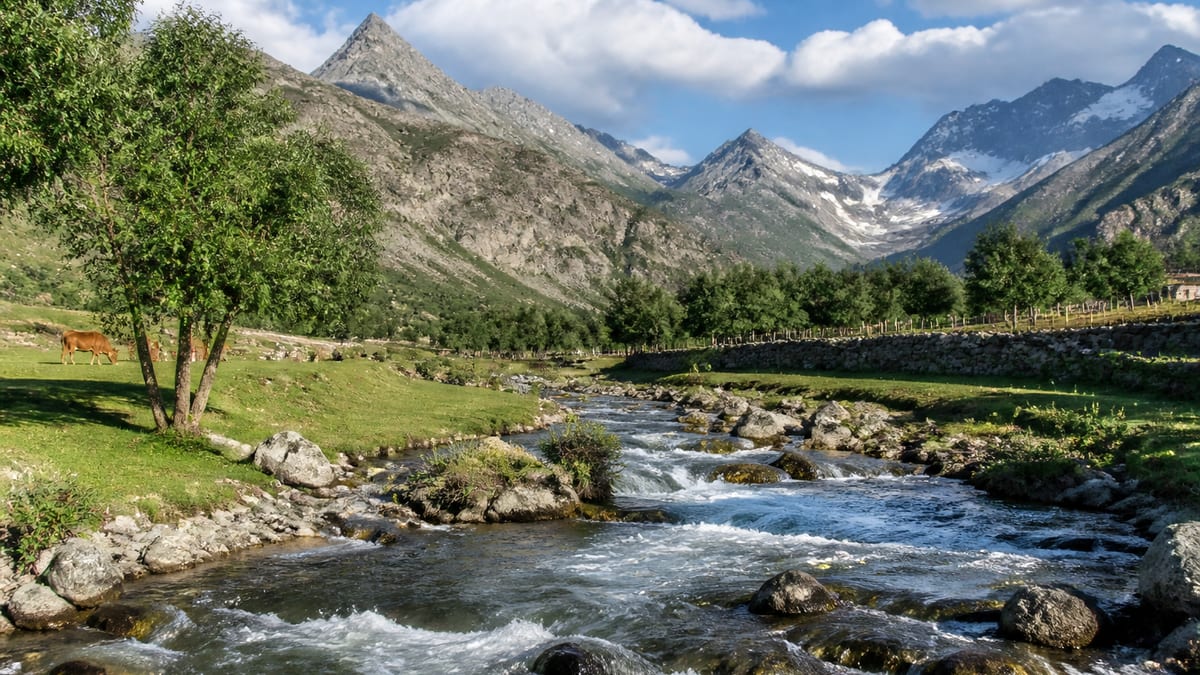
The Brown Bear Hotel Deosai shows up on the Gilgit-Baltistan tourism department’s lodging list, and our directory associates it with Astore District. The listing confirms the name and the district — nothing more. It doesn’t describe rooms, facilities, meals, rates or reviews, and it doesn’t give an exact address, so we don’t either. Please confirm every detail directly with the property before you travel.
The name raises an obvious question: is this hotel on the Deosai plateau? Our pages can’t confirm that, and our Deosai National Park guide says there are no ordinary hotels on the plateau. So this page is about the gap between a name and a location. Below we look at Deosai as a summer-only park, the Astore side as its western gateway, the brown bear the hotel is named after, and what to ask before you plan a night around it.
What the listing confirms, and what it doesn’t
- It confirms: the property name as printed in the department’s hotels directory, associated with Astore District. Our source note reads “Gilgit-Baltistan Tourism Department hotels directory”, accessed 27 August 2026.
- It doesn’t confirm: whether the hotel is open this season, where exactly it stands, how many rooms it has, what they cost, or whether meals, heating or transport are available.
Our Astore destination page puts it plainly. Travellers often assume this hotel sits on the plateau itself. Confirm the actual overnight with the property or your operator, because Deosai access and Astore lake days aren’t always on the same road.
Hotels and guest houses in Gilgit-Baltistan must hold a tourism department licence, meet safety and hygiene standards, and are subject to regular inspections; see hotel and guest house regulations. Being on a list doesn’t tell you whether a property is open on your dates.
Deosai in brief
According to our Deosai guide, Deosai National Park is a high alpine plateau between Skardu and Astore, averaging 4,114 m. It was made a national park in 1993 to protect the Himalayan brown bear. Its Balti name, Ghbiarsa, means “summer’s place” — and that’s exactly how it works. From roughly November to May the plateau is under snow.
Our Astore district record adds a useful detail. Deosai isn’t assigned to Astore, or to any other single district. Writing about the bear, the marmots and the wetlands is filed with Skardu. That’s why a hotel carrying the Deosai name can sit on the Astore list without the park being “in” Astore.
Two ways onto the plateau
Our Deosai guide describes two approaches. Both need a 4×4 — which in practice means a local vehicle with a driver who knows the track.
From Skardu, via Sadpara
This is the shorter approach. The road is paved to Sadpara Lake, then turns into a rough track climbing to the park checkpoint — about 30 km and 1.5–2 hours from Skardu. Most visitors come this way, and many do Deosai as a day trip from Skardu.
From Astore, via Chilam
Leave the Karakoram Highway for the Astore valley and drive to Chilam, the last village. Our Deosai guide puts Astore to the plateau at about 70 km and 3–5 hours. Sources disagree on whether this side is easier, so plan for a 4×4 either way. Chilam is also the junction for the road over the Burzil Pass to Domail Valley.
The full crossing
Skardu to Astore across the plateau is about 150 km and takes 7–8 hours by jeep. Our guide calls it the best way to see the whole park, and it fits a Skardu–Astore–Gilgit loop. If you’re crossing, where you sleep on the Astore side stops being theoretical. Ask the property how far it is from Chilam and from Astore town, and what time you’d need to leave the plateau to arrive in daylight.
When Deosai is open
Deosai is open only in summer. Our guide gives these windows — treat them as approximate:
- Mid-June: the park opens once the road is cleared. In 2026 it opened on 10 June.
- July: wildflowers peak and marmots are everywhere. Several operators call it the best month.
- August: still green, but monsoon rain can wash out the Skardu approach.
- September to early October: golden grass, clear air and freezing nights. The first heavy snow can close the road at any point in October.
- November to May: closed.
If you’re planning around this hotel, ask whether it’s open in the same weeks the park is, and whether it stays open after the road closes. Our Astore page specifically suggests checking that your Astore-side hotel is open on your dates.
The brown bear behind the name
The Himalayan brown bear is why Deosai is a national park. Our Himalayan brown bear of Deosai page notes that department materials describe it as critically endangered and a keystone species of the park. The department’s Deosai page names the park’s wildlife as dominated by brown bears and Himalayan marmots.
Our Deosai guide adds that the best chance of a sighting is early morning or late afternoon, and that a sighting is never guaranteed. Stay in or near the vehicle, keep your distance and never feed bears. If an early start matters to you, ask the property what time breakfast is possible and whether it can help arrange a driver before dawn.
Wetlands and Sheosar
Department materials describe Deosai and Sheosar Lake, also called Blind Lake, as among the world’s highest freshwater wetlands; see Deosai high-altitude wetlands. Our Deosai guide places Sheosar at the western end of the plateau, towards Chilam and Astore, at about 4,140–4,250 m depending on the source. On a clear day you can see Nanga Parbat from its shore.
Permits and park rules
Our pages describe park entry in two ways, so check before you go — and don’t expect us to invent a resolution between them:
- The department FAQ says visitors to national parks must obtain a permit from the Wildlife Department and must not litter or disturb wildlife; see national park visit regulations.
- Our Deosai guide says most visitors don’t need an advance permit and buy an entry ticket at the checkpoint. Anglers need a fishing licence.
Ask the property or your operator which applies in the year you travel. Wildlife viewing is allowed in designated areas with a wildlife department permit; see wildlife viewing regulations. Camping needs a designated site and a tourism department permit, plus Leave No Trace; see camping regulations. We don’t publish fees, because they change.
Altitude, weather and supplies
Deosai is a serious day out, whichever side you sleep on. Our Deosai guide advises:
- Altitude: you’ll spend the whole day above 4,000 m. Acclimatise first, and see a doctor beforehand if you have heart or breathing problems.
- Weather: summer days are mild, but nights fall close to freezing or below. Bring a windproof jacket even in July.
- Signal: expect no mobile signal on most of the plateau. Leave your route with someone.
- Fuel, food and cash: none is available inside the park. Stock up in Skardu or Astore.
- Litter: carry everything out.
Our packing guide covers the rest. Astore town itself sits at about 2,546 m according to our district record, so a night there is a gentler step up than going straight onto the plateau.
Choosing where to sleep for Deosai
Our Deosai guide sets out three realistic options:
- A day trip from Skardu. The simplest choice. Compare Skardu stays such as Mountain Lodge Skardu and Mashabrum Hotel Skardu in the hotels directory.
- Camping inside the park. Operators bring tents to the main camping areas. Follow the park and camping rules.
- Staying on the Astore side. Our guide says Chilam and Astore town have a few simple hotels, and names The Brown Bear Hotel Deosai on the Astore list. The other Astore property on our lists is Rama Bayak & Restaurant.
For many travellers the right answer is a mix — Skardu on the way in, the crossing by day, and an Astore-side night before going on to Rama Lake or Gilgit.
Questions to ask the property before you book
Put the questions in writing and keep the replies:
- Where exactly is the hotel: on the plateau, at Chilam, in Astore town or somewhere else?
- Is it open on your dates, and does it stay open after the Deosai road closes?
- What room types are available, and what’s the full rate for your dates?
- How are rooms heated, and is hot water available on cold nights?
- Are meals available, and can you order an early breakfast?
- Can the property help arrange a 4×4 and driver for the plateau?
- Is there mobile signal or internet, and is there backup power?
- What’s the cancellation arrangement if snow or a washout closes the road?
Get the answers in writing and reconfirm shortly before arrival. Our accommodation options overview explains the main types of stay, and our guest houses guide covers how to book small properties well.
Frequently asked questions
Where is The Brown Bear Hotel Deosai?
Our directory associates it with Astore District. The listing doesn’t give an exact address, so confirm the location with the property before you travel.
Is The Brown Bear Hotel Deosai on the Deosai plateau?
We can’t confirm that. Our Deosai guide says there are no ordinary hotels on the plateau, and our Astore page warns that travellers often assume this hotel is there. Ask the property.
Is Deosai National Park in Astore?
Not exclusively. Our Astore district record says Deosai isn’t assigned to any single district. It lies between Skardu and Astore.
When is Deosai open?
Only in summer. In 2026 the park opened on 10 June, and it usually closes in October when the snow returns. From about November to May it’s snowbound.
How do I reach Deosai from Astore?
Drive to Chilam, the last village, then climb onto the plateau. Our Deosai guide puts it at about 70 km and 3–5 hours from Astore, by 4×4.
How long is the full Skardu–Astore crossing?
About 150 km and 7–8 hours by jeep, according to our Deosai guide.
Why is the hotel called Brown Bear?
We don’t know. Deosai was made a national park in 1993 to protect the Himalayan brown bear, which may explain the name — ask the property if you’re curious.
Will I see a brown bear on Deosai?
Possibly, but it’s never guaranteed. Early morning and late afternoon give the best chance. Keep your distance and never feed bears.
Do I need a permit for Deosai?
Our pages describe it two ways: the department FAQ mentions a Wildlife Department permit, while our Deosai guide says most visitors buy an entry ticket at the checkpoint. Confirm the current rule before you go — we don’t invent a resolution between those two wordings.
Does the hotel serve meals or arrange jeeps?
The listing doesn’t say. Ask the property directly and get the answer in writing.
—
Source: Gilgit-Baltistan Tourism Department hotels directory, Tourism, Sports, Culture, Archaeology & Museums Department, Government of Gilgit-Baltistan. Accessed 27 August 2026. Park, route and season details are from this site’s own guides; confirm current conditions with the property before you travel.